
SWOT: The High-Level Self Exam that Boosts Your Bottom Line
 How to bring maximum benefit to your twice-yearly marketing update.
Strategic planning demands realistic and objective assessment. At least twice each year, use the SWOT analysis to discover key internal and external issues and refresh the strategies and tactics of your marketing plan. Understanding where you are today is fundamental to achieving your future goals.
The well-known SWOT analysis appears disarmingly simple. But avoid the temptation do it quickly or casually. Taking this valuable analysis for granted would be downright unfortunate.
Thoughtfully listing the STRENGTHS, WEAKNESSES, OPPORTUNITIES and THREATS of your situation should be done at least once a year...even better, twice a year. It's a "big picture" exercise that challenges you to compile, analyze and evaluate the significant influences that work for or against your strategic objectives.
When to use a SWOT
When you need a helpful perspective on how your healthcare organization is doing, a SWOT can be extremely helpful. You can use a SWOT to do any of the following:
- Explore possibilities for new initiatives or solutions to problems
- Determine where change is possible. If you find yourself at a turning point, taking inventory of your strengths and weaknesses can reveal priorities along with possibilities.
- Make choices about the best path for your organization by identifying your opportunities for success and warding off threats.
- Adjusting and refining your plans in the middle of their execution. New opportunities in a SWOT may open other decisions, while new threats can close paths that once existed.
A SWOT analysis is useful for hospitals, medical groups, and individuals in private practice—it helps focus your marketing in areas that harbor the strongest benefits. Here are a few ideas to maximize the value and generate effective strategies from this exercise.
Sketching the S.W.O.T. Quadrants
Create a four-part grid on a single piece of paper to provide an overview that helps visualize the relationships.
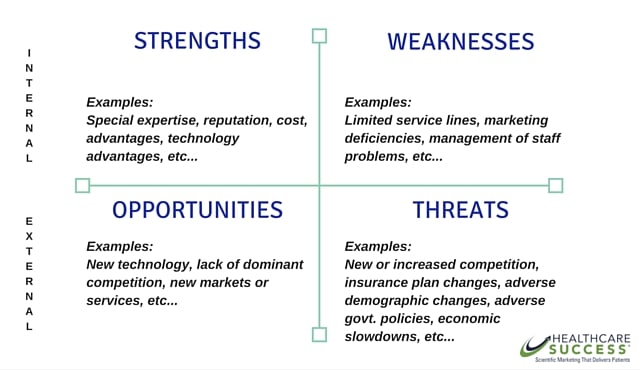
Identify and list the key elements in each quadrant. Get these down on paper as the first step.
Internal: Strengths & Weaknesses
The top two sections (STRENGTHS and WEAKNESSES) both originate internally. These are things that you can control. Strengths are helpful; Weaknesses are harmful.
Strength in a SWOT Analysis
Your strengths involve what your healthcare organization excels at and what sets you apart from your competition. Is it your strong brand? unique technology? Incomparable results? You should be able to identify and analyze your Unique Selling Proposition and make this a part of your strengths section.
List of your capabilities and resources that can be the basis of a distinct competitive advantage. Your strengths are an integral part of your organization, so consider what makes it "tick." Ask: What are the most important strengths? How can we best use them and capitalize on each strength?
Strengths could include:
- a new and/or innovative service
- capabilities or cost advantages
- cultural connections
- extraordinary reputation
- other aspects that add value
- special expertise and/or experience
- superior location or geographic advantage
- Unique values that drive your organization
Weakness in SWOT Analysis
Weaknesses can be preventing your healthcare organization from performing at its optimum level. What areas need improvement (or should be avoided)? Higher than normal turnover? Inadequate supply chain.
Ask: What would remove or overcome this weakness? Weaknesses can sometimes be the absence of certain strengths, and in some cases, a weakness may be the reverse side of one of your strengths. Weaknesses might include:
- absence of marketing plan
- damaged reputation
- gaps in capabilities or service areas
- lagging in technology
- management or staff problems
- own known vulnerability
- poor location or geographic barriers
- undifferentiated service lines
External: Opportunities & Threats
The lower two sections (OPPORTUNITIES and THREATS) both originate externally. These are things that you cannot control. Opportunities are helpful; Threats are harmful.
Opportunities in SWOT Analysis
Opportunities in a SWOT analysis are favorable external factors that could give you a competitive advantage. Because opportunities tend to arise from situations outside your organization, you need to always have an eye on what may happen in the future. The ability to pinpoint and exploit opportunities can make a world of difference in your ability to compete in your healthcare market.
In addition to new or significant trends, what other external opportunities exist and how can we best exploit or benefit from each?
SWOT Opportunities examples might include:
- a market vacated by a competitor
- availability of new technology
- changes in population profile or need
- Competitor vulnerabilities
- lack of dominant competition
- new market segments that offer improved profit
- new vertical, horizontal, or niche markets
Threats in SWOT Analysis
Threats can include anything that stands in the way of your success and can potentially harm your organization. No practice is immune to threats, but too many people miss, ignore or minimize these threats, often at great cost. Ask: What can be done to mitigate each threat? Can a threat become an opportunity?
You can identify threats in a SWOT analysis from considering what your competitors are doing and if you ought to change your emphasis to meet the challenge. Copyin gthem without knowing how it will improve your position can be a mistake, however, so always bear in mind that what your competitors are doing is not necessarily right for you.
Threats could include:
- a competitor has an innovative product or service
- a new competitor(s) in your home market
- adverse changes in reimbursement or regulations
- changing insurance plans and/or contracts for major area employers
- competitors have superior access to channels of distribution
- economic shifts
- loss of key staff or associates
- new or increased competition
- seasonality
- shifts in market demand or referral sources
1. Be Specific: Avoid gray areas, vague descriptions or fuzzy definitions.
2. Be Objective: Ask for input from a well-informed but objective third party; compare it with your own notes.
3. Be Realistic: Use a down-to-earth perspective, especially as you evaluate strengths and weaknesses. Be practical in judging both sections.
4. Apply Context: Distinguish between where the organization actually is today, and where it could be in the future.
5. Contrast and Compare: Analyze (realistically) in relation to your competition i.e. better than or worse than your competition.
6. Short and Simple: Avoid needless complexity and over-analysis.
7. Update your marketing plan and goals: Once the key issues have been identified, define the action steps to achieve change.
Go ahead and send us your SWOT notes for a reality check when you finish.
With your SWOT complete, you’ll be on the road to completing a strategic healthcare marketing plan for your organization.
If you'd like to know more about putting this high-value assessment tool to work in your plan, we would be pleased to provide a well-informed and objective sounding board for you.
Call us today at 800-656-0907, or connect with us here.